

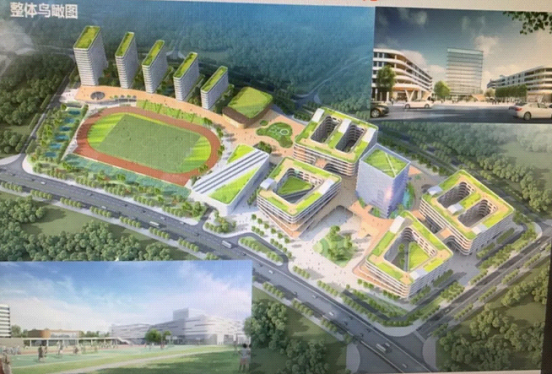
Recently,the “Site Selection Evaluation and Regulatory Plan on Dongguan Songshan Lake 2019-01 Land Project” (hereinafter referred to as the “Plan”) has been delivered and approved on the fourth session of the fourth Urban and Rural Planning Committee of Dongguan Municipality. The city’s first future school will be built in the vicinity of the wetland delta in southern Songshan Lake Park. It will be a boarding school with 72 classes and around 2,760 students.
According to this year’s government work report of Dongguan, efforts will be made to build three high-standard future schools. It is pointed out in the “Plan” that Dongguan will explore and accumulate experience during building the first future school in Songshan Lake area. Dongguan will take into account realities of different areas to make sure that the development of primary education keeps pace with that of society and economy.
First future school will locate at the wetland delta in southern Songshan Lake Park
What is future school? According to the project leader of Dongguan Urban Planning and Design Institute, where the “Plan” is complied, future schoolrests on modern educational information technology and forms a tailored study support system by integrating space, curriculum and technology. In this way, personalized education can be better conducted based on individual learning level, personality, interests and strengths. Therefore, a future school is an innovative school with future orientation that cultivates talent capable of adapting to future development.
Two sites in Songshan Lake are available for building the future school: one lies in wetland delta in the south with an area of 13hectares; another is situated in the core area of Songshan Lake Park with an area of 9 hectares. The one lying in the southern wetland delta is away from the comprehensive service region, facing Hanxi River, adjacent to Liaobu Town to the west, near East Fast Line to the north and Shida Road to the west, which is very convenient in traffic. The people in charge of the “Plan” believed that the wetland delta area meets the site requirements for the future school in terms of urban planning and land planning. This site excels in land size, and is more conducive to service-oriented development, takes into account the purpose of educational facilities serving residential areas, which could drive development of neighboring areas.
The “Plan” shows that the future school covers a total area of about 12.66 hectares,with a floor area ratio of 1.2 and 15,000 square meters of floor area. It contains buildings and facilities such as library, administration center, learning center for junior high schooland senior high school, terrace classrooms, dorms for students, residential area for teachers, stadium, and underground garage.
According to the department responsible for the compilation of the “Plan”,to implement the reform of examination and admission system of senior high school, the future school will be a public secondary school, which cultivates students throughout their secondary education for the purpose of admitting outstanding junior high school students. . The future school adopts a boarding system with about 2,760 students: 48 classes for senior high school education with 40 students per class and 24 classes for junior high school education with 35 students per class. It’s worth noting that the senior high school sector of the future school will admitstudents from the whole city while it remains to be decided whether the junior high sector takes in students from across the city or designated areas.
Future school emphasizes openness and diversity
What does a future school look like? The “Plan” shows that the future schoolwill equip with infrastructure which is green, intelligent and interconnected with each other, and base on integrated, smart and flexible learning scenarios, as well as an open and inclusive learning ecology. The future school will serve as an engine driving learning and innovation, which includes a topological structure with innovation, knowledge and information network, and an AI-supported teacher and curriculum management system.
In terms of space, future school demands standardized and intelligent facilities of higher qualityincluding cultural and sports facilities such as customized and diversified swimming pool, stadium, library, assembly hall and theater as well as living facilities such as quality student dorm, cafeteria and residential area for teachers and other staff.
As for design, future school rejects the standardized design of traditional schools while emphasizes openness, diversity and customization of educational space. Eachsubject has its resource, which breaks the standardized general education design and meets the demands for class-shifting teaching, small-class teaching and group discussion. Future school emphasizes student-centered special design, combining transitional space, outdoor green space, playground and learning area in order to make learning anytime and anywhere possible. School is not merely a learning place but also a social environment. Future school also considers connection with external community, utilization of resources available in society for learning, and reservation of sharing space. Future school also shares some of its resources with the community.
It is also pointed out in the “Plan” that Dongguan will fully utilizes new technology to facilitate reform of facilities, teachers’ training, teaching patterns, educational resources and educational services, and present a school that pursues a modern and future-oriented education mode. Dongguan will strive to lead the province in future education.
Relevant links
How to avoid congestion? The “Plan” suggests to set uptransit stations and public transport such as community bus.
How to avoid congestion following the settlement of future school in Songshan Lake area?
According to people in charge of the “Plan”, if the school is open to take in students from across the city, the favorable location of the school allows fast connection of different districts and areas through Shida Road and East Fast Line. However, the surroundings of the school are yet to be developed and lack connection with other arterial roads. To handle this situation, the “Plan” proposes measures to tackle traffic needs of the neighboring area, that is, to build a road network consisting of two arterial roads, two secondary trunk roads and two branch roads respectively to meet the school’s pick-up need. Among them, No. 32 Road and Jinfu Road as two arterial roads make up the horizontal and vertical structure and Jingye Road and No. 23 Road form an internal micro circular road network with the planned horizontal and vertical roads.
To handlethe problems in rush hours, Dongguan Urban Planning and Design Institute also suggests to build a smart pick-up system underground for stop-and-go; flexible pick-up space on the ground on the western branch road is advised to be reserved during rush hours; parking places can be provided according to actual needs; entrance and exit for vehicles should be laid out scientifically with No. 32 Road being set for entrance only.
Dongguan Urban Planning and Design Institute also proposes to build a terminal with an area of no less than 1,500 square meters in southeastern part of theschool so that buses can be parked during night. A customized public transport solution can also be launched. A shuttle bus line can be introduced upon the demand before and after holidayby linking with Liaobu station of the intercity railway and east bus terminal and establishing bus line the basis of Shida Road. In this way, a public transport system reaches the whole city. In the long term, the latest transit network can also be utilized and connection with nearby transit stations and community bus can be obtained, such as Line 8, 7 and 5.
In addition, a slow lane can be built along No. 32 Road, Jinfu Road, Jingye Road and Cuixiang Road to reach key stations near the school, and the eastern wetland. At the same time, a pedestrian overcrossing crossing No. 32 Road will be added near the pedestrian entrance of the school so that students and parents can cross the street conveniently.